Commercial Oven Master Guide: Types, Selection, and Maintenance for Baking Professionals
For baking studios, bakeries, western restaurants, and private culinary businesses, commercial ovens from Ruban Machinery are absolute core productivity equipment. Many startup entrepreneurs fall into a common trap: thinking that large-capacity household ovens can substitute for commercial ovens to save money. In actual operations, however, household ovens lack sufficient thermal recovery, suffer from uneven temperatures, and offer low batch capacity, failing to keep up with store production demands.A commercial oven adapted to your store's product categories and offering stable performance not only improves product consistency and doubles output efficiency, but also reduces food waste and operating costs. This guide provides a comprehensive breakdown of commercial ovens, including mainstream type differences, purchasing pitfalls to avoid, daily usage, and maintenance methods.
I. Commercial Ovens vs. Household Ovens: More Than Just "Capacity"
Many people wonder if a household oven can replace a commercial model. The answer is: short-term private orders can make do, but routine store operations cannot. The core differences lie in hardware configuration and application scenarios:
Heating and Temperature Control System: Commercial ovens feature high-powered heating elements and multi-probe smart temperature control. High-end models use dual NTC temperature-sensing probes paired with PID algorithms to keep temperature errors within 1°C, offering rapid heating, fast thermal recovery, and even baking without collapse. Household ovens have poor temperature control accuracy (variations up to 10–20°C), often causing uneven coloring and undercooked centers during multi-tier baking.
Body Material and Durability: Commercial ovens use thickened stainless steel bodies that resist high temperatures, warping, and corrosion, supporting over 12 hours of continuous operation for peak hours. Household ovens usually feature thin sheet metal that ages easily, trips breakers, or fails under prolonged high-heat operation.
Capacity and Practicality: Commercial ovens support multi-tier baking and large batch outputs. Convection ovens can run four tiers simultaneously, baking around eighty 75g mooncakes at once to boost efficiency. Household ovens have limited layers and capacity, making batch production twice as time-consuming.
Functional Adaptability: Commercial ovens are optimized for commercial ingredients like bread, cakes, pizzas, and roasted meats, with some models featuring built-in steam, fermentation, and humidity control. Household ovens have single, weak functions that struggle to replicate professional baking textures.
II. Mainstream Commercial Oven Types: Match by Category to Avoid Pitfalls
Commercial ovens are not universally good or bad; they are either suited to your needs or they aren't. Different baked goods and culinary products require completely different oven types:
1. Commercial Convection Ovens (All-Purpose Versatile)
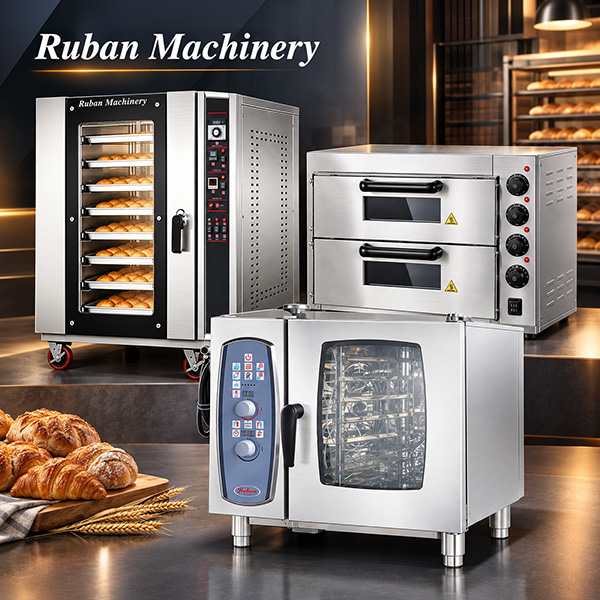
These are the most widely used units in private studios and small-to-medium bakeries. They use high-powered fans to circulate hot air within the cavity, eliminating hot spots and ensuring all-around even heating.
Core Advantages: Even heating, multi-tier baking support, rapid heating, and broad compatibility (cookies, puffs, mooncakes, pastries, small cakes, dried fruits, roasted meats). High-end convection ovens feature reversible high-speed fans for robust penetration and uniform color across tiers.
Ideal Scenarios: Private baking studios, small-to-medium cake shops, bubble tea shops, and light meal cafes focusing on small pastries and batch snacks.
Disadvantages: High fan speeds make them unsuitable for high-moisture, wind-sensitive items like soft sandwich bread or chiffon cakes, which can easily dry out, crack, or collapse.
2. Commercial Deck / Stone Ovens (Professional Bread and Pizza)
These high-end professional baking units serve as the backbone for large bakeries. They combine independent top/bottom heating with stone deck heat storage, relying on radiant heat for stable humidity and temperature to recreate artisan textures.
Core Advantages: Precise built-in steam functionality. When baking artisan bread or toast, steam softens the crust and aids expansion, resulting in crispy crusts and soft interiors. Stone decks offer strong heat retention, giving pizzas crispy, non-rubbery bases with clear coloration.
Ideal Scenarios: Professional bakeries, pizza specialty shops, and baking studios focusing on toast, artisan bread, baguettes, and handmade pizzas.
Disadvantages: Higher price points, slower heating speeds, lower capacity than convection ovens, and narrower compatibility with small batch snacks.
3. Combi Ovens (Multifunctional High-End Commercial)
The "all-around kings" of commercial kitchens, integrating dry convection, pure steam, and steam-convection hybrid modes. They precisely control temperature and humidity, replacing ovens, steamers, fermentation cabinets, and braising ovens in a single unit.
Core Advantages: Complete function coverage from low-temperature fermentation to high-temperature baking and steam-roasting. They deliver stable textures and standardized cooking without requiring constant human monitoring.
Ideal Scenarios: High-end Western restaurants, hotel kitchens, large chain restaurants, and diversified baking stores.
Disadvantages: Expensive, complex to operate, require regular professional maintenance, and offer poor cost-efficiency for small shops.
4. Commercial Deck Ovens (Professional Multi-Layer Large Capacity)
Professional-grade heavy-duty baking equipment featuring independent layer temperature control and robust chamber designs to meet high-intensity commercial production demands. Available in various specifications including 1 deck 1 tray, 2 decks 4 trays, and 3 decks 9 trays to match different store output scales.
Core Advantages: High space utilization, independent layer control without mutual interference, and extremely stable temperature fields. Operators can flexibly activate matching layers according to output volume, balancing large-scale production with energy efficiency.
Ideal Scenarios: Medium-to-large bakeries, baking chains, and industrial workshops focusing on toast, artisan bread, large batches of Chinese/Western pastries, and puff pastries.
III. Core Purchasing Criteria: Avoiding 90% of Buying Pitfalls
When buying a commercial oven, do not just look at price and capacity. Focus on core configurations that match your product line and output volume:
1.Match Product Category First, Then Capacity: For small batch items like cookies, mooncakes, and puffs, prioritize convection ovens. For toast, artisan bread, and pizza, stone deck ovens with steam and heat retention are essential. For diversified dining on a sufficient budget, choose a combi oven. For secondary support in small shops, countertop ovens work well.
2.Temperature Control System: Commercial baking cannot tolerate large temperature variances. Choose digital displays with multi-probe sensing and PID intelligent control (temperature error within 1°C). Avoid simple mechanical controls and single-probe models that cause batch failures.
3.Body Material and Build Quality: For high-frequency store use, choose full 304 stainless steel inner cavities and thickened bodies that resist high heat, corrosion, warping, and cleaning wear. Double-layered tempered glass doors lock in heat and let you monitor baking without opening the door.
4.Power and Voltage: Small countertop ovens usually run on standard 220V power, while large deck and combi ovens require 380V industrial power. Reserve the proper electrical circuits, breakers, and wiring before equipment delivery to prevent costly rework.
5.Door and Structural Design: Front-swing doors offer easy cleaning and tight seals but consume kitchen space. Pull-down doors save space in tight kitchens but have slightly weaker seals and cleaning dead zones. Choose based on your kitchen layout.
6.Additional Features: New store setups benefit from programmable timers, constant humidity, memory menus, and overheat protection. Saving standard parameters eliminates manual adjustments and ensures consistent output.
IV. Daily Usage Tips: Reducing Waste and Enhancing Quality
Preheat Thoroughly: Commercial ovens heat quickly, but cavity heat storage takes time. Always preheat for 10-15 minutes until stable before loading items to prevent uneven color, raw centers, or under-rising.
Space Out Trays Properly: During multi-tier convection baking, leave gaps around the edges of baking sheets to let hot air circulate freely. Avoid overcrowding single layers, which blocks airflow.
Adjust Steam and Fan Speed On Demand: Turn on steam early when baking artisan bread to soften crusts and promote expansion. Increase fan speed for dry, crispy pastries and cookies, but lower fan speeds for soft cakes and toast to prevent surface cracking.
Minimize Door Openings: Opening commercial oven doors causes sudden temperature and moisture drops, leading to product collapse, shrinkage, and uneven coloration. Load and retrieve items efficiently.
V. Maintenance and Common Misconceptions
1. Daily Maintenance Essentials
Daily Cleaning: Clean out food residue, grease, and stains from the cavity and trays after cooling down to prevent carbonization, odors, and heating interference. Regularly wipe glass doors and door seals.
Component Checks: Monthly inspections of heating elements, fans, and thermal probes ensure proper operation and clear oil buildup from sensor heads. Check power cords and terminal connections to prevent aging or looseness.
Long-Term Storage: Clean and dry the inner cavity thoroughly, disconnect power, and apply dust protection if the store closes down temporarily to prevent rust and moisture damage.
2. Common Beginner Pitfalls
Pitfall 1: Higher heat means faster baking. Excessive heat burns exteriors while leaving interiors raw. Always follow standardized target temperatures and use low-and-slow baking when needed to lock in moisture.
Pitfall 2: Convection ovens can bake everything. High wind speeds make convection ovens poorly suited for delicate chiffon cakes, fresh cream cakes, or soft sandwich bread, causing deformation and collapse.
Pitfall 3: Household ovens can substitute for commercial units. While usable for short-term small orders, long-term business use will suffer from thermal drop-offs, temperature variances, and high waste rates.
VI. Company Profile & Contact Information
Company Name: Ruban Machinery Global Co Limited
Headquarters & Showroom: Foshan, Guangdong, China
Official Website: www.rubanglobal.com
WhatsApp: +86 18814186761 (Feel free to contact us anytime for the latest product videos, electronic catalogs, and wholesale quotes!)
Main Business: Specializes in the factory direct sales and global bulk export of commercial kitchen equipment, bakery machinery, commercial refrigeration solutions, and food processing equipment.



 Network Supported