Home

Blogs

Blogs

  • The Art of Precision: Automated Multi-Head Batter Depositing 🤖🧁
    The Art of Precision: Automated Multi-Head Batter Depositing 🤖🧁
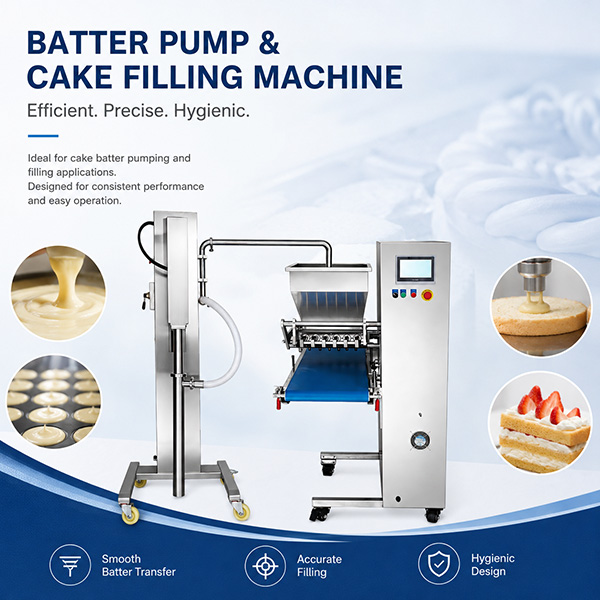
    High Precision, Zero Drips: How Ruban Machinery’s Automatic Multi-Head Cake Depositor Reshapes Modern Bakery Plant Capacity Quick Answer The Industrial Automatic Multi-Head Cake Depositing Line, independently developed by Ruban Machinery, is an intelligent volumetric filling solution custom-built for medium-to-large food factories, central kitchens, and cupcake or muffin production lines. Combining a high-precision smart control system with a food-grade blue conveyor belt, this equipment supports synchronized, high-speed batter depositing onto multi-cavity trays, completing an entire tray in just seconds. It not only eliminates the inefficiencies and dripping issues of traditional manual portioning but also achieves industrial-grade standardization with a near-zero weight margin of error. Key Takeaways Synchronized Multi-Head High-Efficiency Depositing: Supports custom, non-standard stainless steel nozzles (such as 6-head or 8-head configurations) to fill an entire row of baking trays rapidly in one go. Rigorous Weight Accuracy: Driven by pneumatic portioning and integrated with a PLC touch-screen system, real-machine testing proves exceptionally high dosing accuracy for flawless batter weight control. Full-Line Automated Continuous Feeding: Can be equipped with an independent stainless steel automatic feeding pump system to achieve a seamless, fully automated workflow from mixing to depositing. Why Is an Automatic Multi-Head Depositor an Inevitable Trend for Large-Scale Bakery Line Upgrades? When facing high-volume, high-density paper cups or mold trays, traditional manual dispensing with handheld funnels or single-head depositors is slow and causes severe worker fatigue. Even worse, manual operation makes it nearly impossible to avoid batter tailing and dripping onto tray edges. This not only leads to hidden ingredient waste but also demands substantial labor afterward to scrub away burnt residue from the tray rims.     The intelligent multi-head depositor from Ruban Machinery shatters this operational bottleneck. As rows of cake paper cups or molds move smoothly along the blue conveyor belt, the machine utilizes photoelectric sensors to automatically, cleanly, and instantly complete synchronized cutting and volumetric injection. This flawless, robotic performance ensures every single baked cake is perfectly consistent in weight and evenly colored after baking—serving as the rock-solid foundation for bakery brands aiming to scale their business. FAQ (Frequently Asked Questions) Q: Can this multi-head depositor adapt to the non-standard baking tray layouts we already use in our plant? A: Absolutely. This is the core competitive advantage of Ruban Machinery. Whether your setup features a 4-head, 6-head, 8-head, or 9-head layout, or even highly dense, non-standard arrays for egg tart shells and cupcakes, our engineering team can custom-tailor stainless steel nozzle molds one-on-one based on your tray dimensions. This guarantees that the centers of the nozzles align flawlessly with your tray cavities.   Q: Is the material pump system mandatory? Can it be cleaned separately? A: The automatic material lifting pump is an independent automation system. If you run a high-capacity production line, we highly recommend integrating the pump to automate batter transport, eliminating the hassle of manual reloading. However, if you are operating on a limited budget or managing a small-to-medium workshop with frequent product changeovers, using the main machine’s hopper alone works perfectly. The entire unit is engineered with a quick-release tri-clamp design, making direct teardown and cleaning incredibly convenient.  
  • Automatic Dough Divider
    Automatic Dough Divider
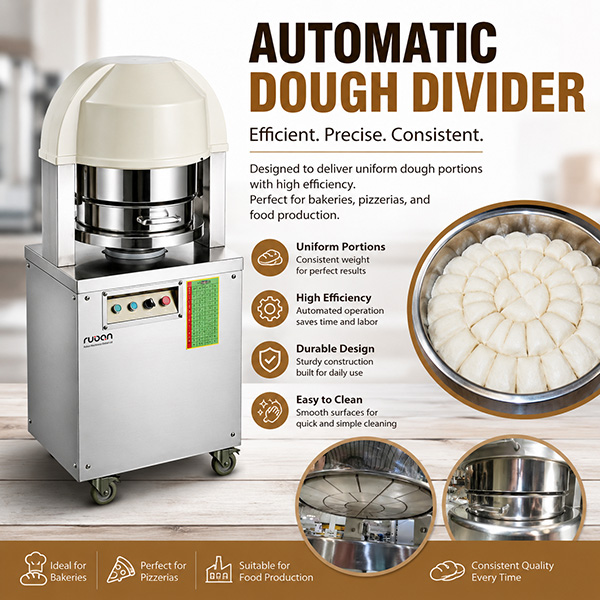
    Commercial Automatic Dough Divider | High Precision & Efficiency, Your Top Choice for Scaling Up Bakery Capacity This fully automatic dough divider is a high-efficiency food prep solution custom-engineered for bakeries, pizzerias, and central kitchens. Constructed entirely from food-grade stainless steel and equipped with silent swivel casters, it offers flexible mobility, effortless cleaning, and seamless integration into any commercial kitchen layout. With its one-touch automated operation, you can completely eliminate tedious, error-prone manual portioning. Experience standardized dough division, slash labor costs, and achieve a faster, more worry-free prep workflow. Food-Grade Stainless Steel Body:** Safe, highly durable, and remarkably easy to clean. One-Touch Automated Operation:** Intuitively designed so even beginners can master it instantly. Silent Swivel Casters:** Ensures effortless mobility and flexible positioning across various kitchen layouts. Versatile Portioning Capabilities:** Perfectly handles diverse dough dividing needs for bread, pizza, buns, steamed buns, and more. Premium Craftsmanship & Details Built for Safe, High-Frequency Commercial Use From the control panel to the internal core components, every single detail is engineered to withstand the rigorous demands of busy commercial kitchens: User-Friendly Control Panel:** Features dedicated Start, Stop, and Emergency Stop buttons alongside gear-adjustment switches. The clean, intuitive interface requires zero complex training, drastically reducing the risk of accidental misoperation. Food-Grade Stainless Steel Dividing Chamber:** Designed with a removable portioning chamber that features a smooth, seamless inner wall. This not only guarantees hygiene and safety during division but also simplifies teardown and sanitization, preventing bacterial growth from trapped dough residue. Precision Weight Scale Gauge:** Located on the side of the machine for quick weight adjustments. Operators can rapidly calibrate parameters to match different recipes and batch specifications, keeping dividing margins of error to an absolute minimum for uniform results. Precision Engineered Cutting Disc | Ensuring Every Single Dough Portion is Uniformly Standardized The dividing disc is the "heart" of this machine. Forged via an injection-molding process using food-grade stainless steel, it undergoes strict precision calibration to ensure perfectly symmetrical dividing lines. During operation, the disc applies uniform downward pressure, instantly cutting large dough batches into multiple small, equal-weight portions. The resulting cuts are perfectly clean and smooth—without stretching or damaging the gluten structure—preventing the uneven fermentation and inconsistent sizing issues caused by manual cutting. The blade assembly can be configured for various dividing specifications (commonly 30, 36, or 40 pieces) to satisfy the rigorous portioning standards required for breads, pizza crusts, and traditional pastries, serving as the ultimate backbone for standardized mass production. Visible Portions, Consistent Output, Zero Waste The finished dough pieces showcase the true precision and stability of this equipment: every single portion is perfectly uniform in size and weight, featuring crisp, clean cuts with absolutely no stretching or deformation. When your dough portions are identical, they ferment and bake evenly under the same heat, guaranteeing a highly consistent texture and appearance for the final product. This effectively eliminates problems like under-baking, burning, or texture variations caused by uneven sizing. By wiping out manual portioning discrepancies, you significantly cut down on ingredient waste and lower your production costs. Whether you are crafting fluffy artisan bread, chewy pizza crusts, or soft steamed buns, this machine delivers the stable, consistent output you need to build a standardized, premium brand that drives customer satisfaction.        
  • Detailed Guide to Commercial Spiral Dough Mixers | The Top Choice for Bakeries
    Detailed Guide to Commercial Spiral Dough Mixers | The Top Choice for Bakeries
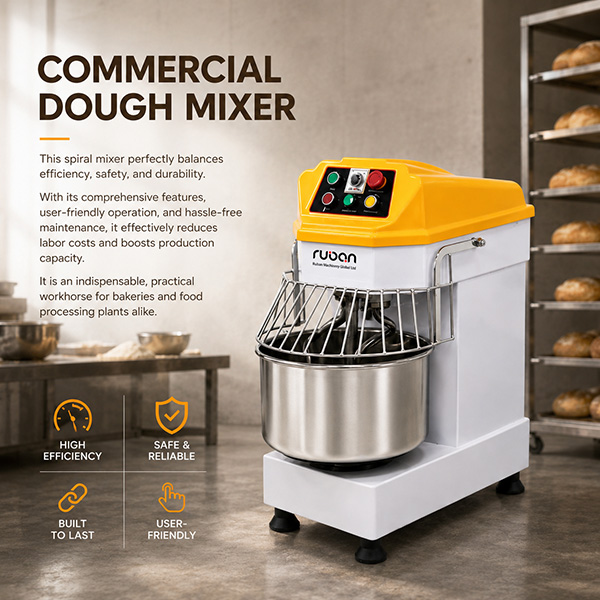
    For commercial operations such as bakeries and pizzerias, a premium dough mixer directly impacts production efficiency and the final texture of the baked goods. Below is a detailed component-by-component breakdown of this spiral mixer. Overall Appearance & Design Featuring a classic commercial color palette, this unit boasts a solid and stable structure. It is equipped with non-slip foot pads at the base to ensure steady operation without shifting.  Both the body and the bowl are crafted from food-grade materials. Its compact footprint seamlessly fits into various kitchen layouts,  while the smooth surfaces allow for effortless wipe-down cleaning. Control Panel The control area features an intuitive layout that is easy to master.  It comes equipped with dual-speed (fast/slow) buttons to switch speeds depending  on the dough-kneading stage and supports a timer function for unattended operation. Inch (jog) and reverse functions are also built-in for easy dough inspection and clearing jams. A prominent red emergency stop button ensures instant shutdown in unexpected situations, maximizing operational safety. Safety Guard Net A heavy-duty stainless steel safety guard is installed over the bowl opening to effectively prevent accidents during operation.  The optimized grid design ensures an unobstructed view,  allowing operators to monitor the dough consistency at any time while preventing ingredients from splashing out, fully complying with commercial safety standards. Dough Hook & Bowl Both the spiral dough hook and the large-capacity bowl are crafted from premium food-grade stainless steel, ensuring corrosion resistance and a non-stick finish.  The specialized spiral hook design kneads the dough thoroughly from all angles, leaving zero blind spots.  This promotes optimal gluten development,  guaranteeing a uniform texture and consistent quality for every batch of dough—perfect for breads, pizzas, pastries, and more. Conclusion This spiral mixer perfectly balances efficiency, safety, and durability.  With its comprehensive features, user-friendly operation, and hassle-free maintenance, it effectively reduces labor costs and boosts production capacity. It is an indispensable, practical workhorse for bakeries and food processing plants alike.
  • Commercial Double Deck Electric Pizza Oven for Professionals
    Commercial Double Deck Electric Pizza Oven for Professionals
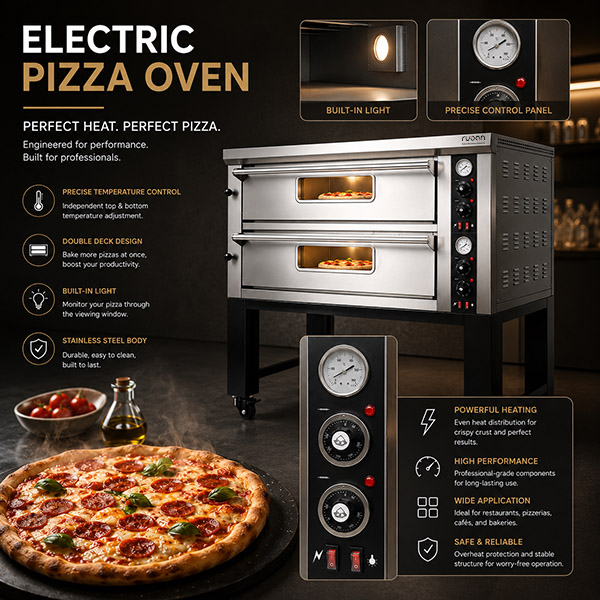
    Premium Double Deck Electric Pizza Oven – Built for Professionals Perfect Heat. Perfect Pizza. Elevate your culinary business with our commercial-grade  Electric Pizza Oven. Engineered for high-volume performance and ultimate precision, this heavy-duty oven is the ultimate solution for pizzerias, restaurants, cafés, and bakeries looking to boost their productivity. Why Choose Our Commercial Pizza Oven? Double Deck Design & High Productivity: Bake more pizzas simultaneously across two spacious decks to significantly cut down customer wait times during peak hours. Precise Temperature Control: Features independent top and bottom temperature adjustments, allowing you to achieve the perfect balance of a crispy crust and perfectly melted toppings. Powerful & Even Heating: Designed with professional-grade components that ensure even heat distribution for consistent, gold-standard results every single time. Heavy-Duty Stainless Steel Body: Crafted from durable, easy-to-clean stainless steel that is built to last in demanding, fast-paced commercial kitchens. Smart & Safe Operation: Equipped with built-in high-visibility lights and viewing windows for easy monitoring, alongside advanced overheat protection for worry-free operation. 🌍 Global B2B Wholesale & Distribution Available As a leading commercial kitchen machinery manufacturer, we offer competitive factory-direct pricing, stable supply chains, and customization options for worldwide distributors.  
  • The Complete Guide to Choosing a Commercial Cake Display Cabinet
    The Complete Guide to Choosing a Commercial Cake Display Cabinet
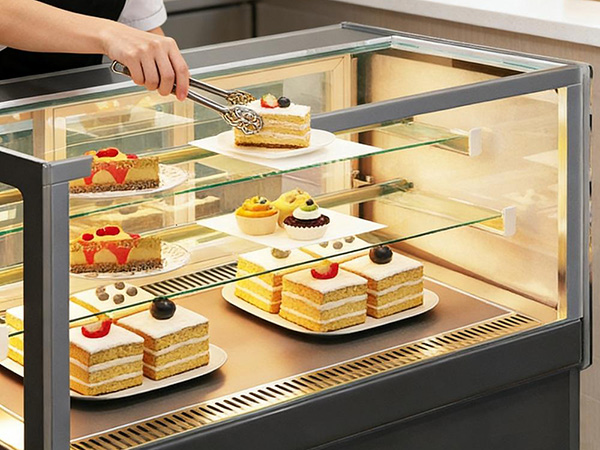
    The Complete Guide to Choosing a Commercial Cake Display Cabinet A commercial cake display cabinet is core equipment for bakeries, dessert shops, and cafes, serving both product display and preservation. Its performance directly affects cake appearance, texture, and sales. This objective, brand-neutral guide will help you make the right choice by breaking down types, cooling systems, dimensions, materials, and long-term operating costs.   1. Types of Commercial Cake Display Cabinets & Suitable Scenarios The most common models are categorized by structure, door style, and viewing angle.   1.1 Right-Angle (Square) Cabinet Appearance: Straight, rectangular glass panels. Advantages: Large capacity, easy to arrange and clean, cost-effective. Disadvantages: Slightly less visual appeal than curved cabinets. Best for: Bakeries with a wide range of cakes Shops with limited space and a moderate budget 1.2 Curved-Front Cabinet Appearance: Large, curved front glass. Advantages: Premium look, better display effect, more comfortable for customers to view. Disadvantages: Slightly higher price, harder to clean corners. Best for: Trendy dessert shops, high-end cake stores Stores focused on visual appeal and social media photos 1.3 Front-Opening Cabinet Door style: Hinged doors that open forward. Advantages: Easy access for customers, large display area. Disadvantages: Takes up front space; not ideal for narrow aisles. Best for: High-traffic stores with direct customer self-service 1.4 Rear-Opening Cabinet Door style: Staff restock from the back; customers only view from the front. Advantages: Hygienic, dustproof, keeps cold air in, energy-efficient. Disadvantages: No customer self-service. Best for: Chain stores and branded shops with strict hygiene standards 2. Cooling Systems: The Most Important Decision Cooling type determines preservation, noise, energy use, and condensation.   2.1 Fan-Cooled (Air-Cooled) – Recommended How it works: Fan circulates cold air evenly. Advantages: Fast cooling, even temperature Low frost buildup, less fogging on glass Cakes dry out less Disadvantages: Slightly higher price, mild noise. Best for: Most cakes, mousses, desserts, and cream-based products. 2.2 Static-Cooled How it works: Natural cooling via condenser pipes. Advantages: Lower cost, quiet, energy-efficient. Disadvantages: Uneven temperature Frost buildup, foggy glass Requires regular defrosting Best for: Very tight budgets, temporary use, basic small shops.   Recommendation: For professional cakes and desserts → choose fan-cooled. For basic display and tight budgets → static-cooled is acceptable.   3. Size & Capacity: Match Your Shop Space Common lengths: 0.9m / 1.2m / 1.5m / 1.8m / 2.0m Typical height: 110cm–130cm Typical depth: 60cm–70cm Quick Size Guide Small shop / kiosk: 0.9m–1.2m Standard dessert shop: 1.2m–1.5m Large store / flagship: 1.8m–2.0m   Notes: Leave at least 10cm of space on all sides, back, and top for ventilation. Install on a flat, strong floor to reduce vibration and noise.   4. Temperature & Suitable Products Colder is not better. Standard cakes / cream / mousse: 2℃–8℃ Chocolate / cheesecake: 5℃–10℃ (some types) Too cold → cakes crack, texture suffers Too warm → cream spoils, collapses, bacteria risk Key buying points: Must have precise digital temperature control Small temperature fluctuation Stable performance at 2–8℃   5.Glass, Lighting & Materials: Appearance & Durability   5.1 Glass Recommended: Double-layer tempered glass Benefits: Better insulation, less fogging, explosion-proof, clearer view Front glass preferably with anti-fog heating   5.2 Lighting Recommended: LED warm white / natural light Effect: Makes cakes look fresh and appetizing Avoid: Cold blue light or overly dim yellow light 5.3 Cabinet Materials Body: Stainless steel, durable and easy to clean Shelves: Tempered glass, height-adjustable Seals: Thick, tight gaskets to lock in cold air   6. Energy Use, Noise & After-Sales Service Power consumption Fan-cooled > Static-cooled Larger cabinets use more power. Choose energy-efficient, inverter compressors to save electricity. Noise Place away from customer seating. Ideal compressor noise: ≤ 60 decibels. Warranty Compressor warranty: at least 3 years Overall warranty: at least 1 year Prefer brands with wide service coverage and available parts.   7. Quick Decision Checklist Premium display → curved fan-cooled cabinet High capacity & value → right-angle fan-cooled cabinet Strict hygiene → rear-opening Customer self-service → front-opening Cakes, mousse, cream → fan-cooled, 2–8℃ Small space → 1.2m Large store & high volume → 1.5m–1.8m Long-term business → double anti-fog glass + LED lighting  
  • Complete Guide to Choose a Commercial Bread Oven
    Complete Guide to Choose a Commercial Bread Oven
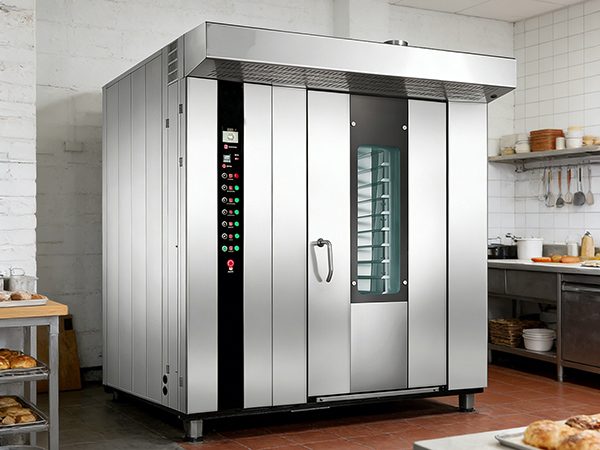
    Complete Guide to Choose a Commercial Bread Oven. To open a Bakery or Baking Shop. Choose the right oven for stable output and doubled efficiency; Choosing wrong can result in electricity, labor, and damage to the finished product. This article uses clear text and practical points to help you quickly select a commercial bread oven that is suitable for you.   First, let's understand: what are the types of commercial bread ovens? 1. Deck Oven (iron and stone deck to choose) - preferred for European bread/baguettes. Core features: each deck independent temperature control, stone slab heat storage. Suitable products: European bread, baguettes, soup, pizza. Advantages: crispy outer skin, beautiful cutting lines, and wheat fragrance. Suitable for stores: specializing in artisan bread and boutique baking shops 2. Hot air circulation oven (wind stove) - Mass production pastry/toast Core features: strong hot air, multi-layer baking, uniform heating Suitable for products: toast, meal buns, croissants, biscuits, puff pastry Advantages: high efficiency, good consistency, suitable for mass production Suitable for stores: walk-in bakeries, chain stalls   3. Rotating rack oven - Large factory/central kitchen Core features: super large capacity, continuous baking Suitable for: daily production of thousands of pieces, factory production   Second: 5 core parameters must be considered when choosing: 1. Capacity and number of layers (choose according to production volume) Small store: one deck two pans / two deck four pans Medium store: three deck six pans / three deck nine pans High yield store: three deck twelve pans/four deck sixteen pans Suggestion: Reserve 20% margin to cope with peak season orders.   2. Energy type: Electricity vs Gas Advantages of electric ovens: precise temperature control, simple installation, clean requirements: mostly require 380V three-phase electricity. Gas ovens advantages: fast heating, low long-term use cost. Requirements: gas connection required. Approval for installation. Suggestion: Small shops should prioritize electricity use; Large factories or big daily baking capacity shops are more choosing gas.   3. Temperature control accuracy (determines whether bread tastes good or not) High quality commercial oven: temperature difference within ± 3 ℃ Must see function: independent temperature control (upper and lower fire/layered temperature control) Timing function: easy to use   4. Material and workmanship Inner liner: priority stainless steel, durable and easy to clean Layers: thickened stone slab/cast iron, good heat storage Door body: double-layer tempered glass, good insulation, anti scalding   5. Power and installation conditions confirmed in advance: store voltage, power, air switch, ground wire, mismatched circuit will trip and burn the machine!    
Prev
1 2
Next

leave a message

leave a message
If you are interested in our products and want to know more details,please leave a message here,we will reply you as soon as we can.
submit

Home

About Us

WhatsApp

contact

Enter product details and other specific requirements to receive an accurate quote.
leave a message
If you are interested in our products and want to know more details,please leave a message here,we will reply you as soon as we can.
Submit